Tuesday, April 22, 2014

1. Germany as a Military State

With Adolf Hitler's rise to power, came many violations of the Treaty of Versailles, largely the prohibition on the growth of Germany's army.  Hitler chose to rebuild the army of Germany rallying support of this movement gathered behind the narrative promoted by Hitler that the Treaty of Versailles was outrageous and that rebuilding the army was a way to restore the glory of Germany.

As Hitler began his quest for more living space he built support at home through intense propaganda campaigns, including but not limited to speeches, posters, signs, and youth programs.  This propaganda was successful in convincing the German people to accept rationing programs, join the growing military, work in vast industrial centers, commit terrible injustices against other people, and go to war against non-aggressive nations.

Hitler glorified the military and his goals as a leader, and was successful in creating a militarized nation that was able to conquer and destroy large parts of Europe.
In March 1936, Hitler mobilized to troops to remilitarize the Rhineland.

2 Major Changes in the Post War Era

After Japan's surrender to the Allied Powers, American General Douglas MacArthur accepted the surrender and took over the occupation and restructuring of Japan.  During this time the country underwent a great number of changes.

1. Japan became a parliamentary democracy which was laid out in the constitution which was drafted by MacArthur and American consultants.  The democracy went into effect on May 3, 1947.  In this democracy all individuals, including women, above the age of 20 were able to vote for both houses of Parliament and the popularly elected Prime Minister.

2.  Another important change Post War is that America became allies with Japan upon the ratification of the Peace treaty in September 1951.  This positive relationship has grown and fostered ever since this point.

Similar to the change after World War 1, the World underwent immense change, much of which was experienced by Japan.


4. Lasting Effects of the Holocaust

"A thousand years will pass, and still this guilt of Germany will not have been erased."


Angela Merkel at the inauguration of the Roma Holocaust Memorial.
Hans Frank, the slayer of the Poles, said this comment during the Nuremberg Trial.   In 2008, Angela Merkel, Chancellor of Germany said, “the mass murder of 6 million Jews, carried out in the name of Germany, has brought indescribable suffering to the Jewish people, Europe and the entire world.”  She also goes on to say that Germans are filled with shame for what they, as a nation, did to the Jewish people of Germany and Europe.  While this tragedy should never be forgotten, perpetual guilt does not allow individuals or groups to grow and evolve as a culture.  The Germans and the Jewish people around the World should truly make peace with the event and begin to grow together.  


Furthermore, the world lost many great thinkers and business men who were of Jewish descent or other groups of people considered to be inferior.  To this day we will never know how many geniuses like Albert Einstein, a Jewish man who escaped Europe, or great business leaders could have been lost, all of that potential that was lost forever.
Main Germany Holocaust Memorial outside of Berlin

Saturday, April 19, 2014

3. The beginning of U.S. involvement in WW2 and Japanese Internment Camps

While the U.S. resisted entry into World War 2, Japan forced the hand of the United States with the bombing of Pearl Harbour, no longer could they sit idly by while Europe was burning in the flames of war.  With this direct attack on American soil, the U.S. was forced to strike back, but along with their entry into the war came an intense distrust of Japanese Americans due to their cultural link to the Japanese homeland.  Governmental propaganda built up prejudice against 127,000 Japanese Americans.  On February 19, 1942 President Roosevelt set up a program of internment to defend the perceived threat of the Japanese American people.  These Americans who happened to be of Japanese descent were rounded up by the military and relocated to secluded areas with no freedom to prevent these dangerous American citizens from aiding Japan in a possible invasion of America. This atrocious violation of American rights carried on from 1941 to 1946 containing 31,275 against their will without just cause. 
Pictured above are the barracks in which Japanese Americans were confined to in an internment camp in Amache, Colorado.

2. Battle of Stalingrad

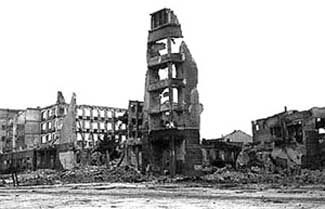
        In the summer of 1942, Hitler send the 6th army to conquer Stalingrad, a major industrial center of the U.S.S.R.  The battle began on August 23, 1942 when the German Luftwaffe began night bombings on the city, crumbling the city to ruins.  Stalin, however refused to yield the city to Germany.  By November 9, Germany controlled 90% of the city but the tide of the battle shift in the favor of the U.S.S.R. when the bitter Russian winter came about.  The bitter conditions and the resurgence of Soviet attacks forced the Germans to surrender on February 2 , 1943.  The remaining 90,000 German troops surrendered to the Soviets.  From this point on the Germans were forced to be on defensive rather than offensive.  While the lives of 1 million Soviets were lost, Germany's inability to fully capture Stalingrad truly changed the outcome of the war.
Pictured above is the devastation that was the result of the Luftwaffe bombing of Stalingrad.